A walking aid, such as a cane or walker, can help you stay more independent and prevent falls. Remember to keep your walking aid within easy reach when you're in a chair or in bed. And learn how to use it safely so you don't injure yourself.
Be sure the cane or walker is the correct height. Hang your arm loosely at your side, and measure the distance from your wrist to the floor. The distance should be the same as the height of your cane or walker. Talk with your health care team to find out what walking aid is right for you, its size, and how to use it.
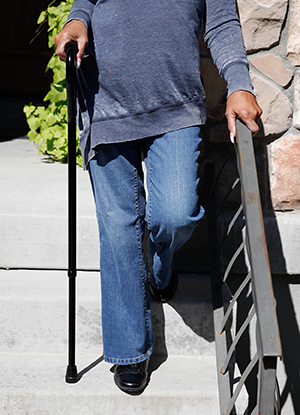
Using a cane
If you have a stronger side, hold the cane on the side of your stronger leg.
-
Get your balance.
-
Move the cane and your weaker leg forward at the same time.
-
Support your weight on both the cane and your weaker side.
-
Step with your stronger leg.
-
Start again from step 1.
Using a walker
-
Roll the walker (or lift it, if you're using one without wheels) forward about 12 inches. Try to keep your back straight and look forward as you move the walker.
-
Step forward with your weaker leg first to about the center of the walker.
-
Use the walker to help keep your balance.
-
Bring your other foot forward to be even with your weaker leg.
-
Start again from step 1.
Tips
-
Check with your doctor about the right walking aid to use. Ask about a walker with a seat attached.
-
Contact your health insurance company. Canes and walkers are usually covered by Medicare and other insurers.
-
Check the tips of your cane or walker to make sure they have nonskid covers and aren't worn or uneven.
-
Wear shoes that fully support your feet. Shoes with nonskid soles and low-heels are good choices.
-
Never walk without shoes, even in your home.
-
Move slowly from room to room. Don't rush.
-
Remove floor clutter, electric cords, and throw rugs from floors and stairs to reduce the risk of tripping.
-
Install a nightlight along the route between your bedroom and the bathroom. Move furniture so there is a clear, wide pathway between rooms.
-
Sit down to get dressed.
-
Use a fanny pack or backpack to keep your hands free.
-
Get help for jobs that mean climbing, even on a step stool.
-
Don't try going up or down stairs using a walker.
Featured in
Online Medical Reviewer: Jessica Gotwals RN BSN MPH
Online Medical Reviewer: Marianne Fraser MSN RN
Online Medical Reviewer: Thomas N Joseph MD
Date Last Reviewed: 04/01/2025
© 2000-2026 The StayWell Company, LLC. All rights reserved. This information is not intended as a substitute for professional medical care. Always follow your healthcare professional's instructions.